Deciding between online coaching vs gym trainer for older men is not just a matter of convenience-it's a question of how you want to train, what outcomes matter most, and how your health and schedule shape those choices. Older men face unique priorities: preserving muscle mass, improving balance, managing chronic conditions, and reducing injury risk. This guide breaks down the trade-offs clearly so you can choose with confidence and take practical next steps.
Start by identifying your primary goals. Are you aiming to build strength, improve cardiovascular fitness, lose body fat, or reduce fall risk and regain mobility? Each objective favors different approaches. For instance, strength and hypertrophy require progressive loading and technique coaching-both achievable online or in a gym, but the path and support differ. Prioritize the outcomes that matter most to you and use them as the lens for comparing options.
Next consider health status and medical history. Many older men have conditions like osteoarthritis, hypertension, diabetes, or previous injuries. Those issues influence whether hands-on supervision is necessary. If you have complex medical needs or fall risk, in-person training may provide quicker corrections and a safer environment. Conversely, if you are generally healthy and self-motivated, online coaching can offer tailored programming with the flexibility to train at home.
 Online coaching and gym trainers both deliver personalized plans, but they differ in delivery, accountability, and cost. Online coaching typically offers a structured program delivered via an app, video calls, and message support. It is highly flexible and often more affordable. Gym trainers give immediate hands-on cueing, spot protection for lifts, and in-person motivation. The right choice depends on how much supervision you need and how valuable face-to-face interaction is to your progress.
| Feature | Online Coaching | Gym Trainer |
|---|---|---|
| Cost | Typically $75-$200 per month for structured plans or $75-$200 per package depending on services | Typically $40-$120 per session; packages vary-higher for specialized trainers |
| Flexibility | High-train anytime, anywhere with programming and video demos | Moderate-scheduled sessions required and dependent on location |
| Technique correction | Remote-video feedback and cues via apps; depends on recording quality | Immediate-hands-on correction, spotting, and tactile feedback |
| Accountability | Built-in through messaging, tracking, and check-ins; self-driven | Strong-scheduled appointments and social pressure improve attendance |
| Equipment | Works well if you have basic equipment or are flexible with bodyweight and bands | Access to a wide range of machines, free weights, and rehab tools |
Numbers and charts summarize differences, but the nuance matters. For example, cost comparisons vary with frequency-weekly one-on-one sessions add up quickly, whereas monthly online subscriptions can be economical. Technique correction via video is effective for many exercises, but for complex compound lifts or rehabilitative work, a hands-on trainer shortens the learning curve. Weigh these practical trade-offs against what you enjoy and what will keep you consistent.
Safety should be the principal consideration for older men. A qualified professional-online or in-person-should begin with a medical and movement screen, ask about medications, and identify contraindications. Good programs include adaptations for joint pain, controlled progression to prevent overload, and clear guidance for when to pause or modify workouts. If your health is complex, insist on a trainer familiar with clinical issues or collaborative care with your physician or physical therapist.
Personalization is where a great trainer shines. In-person trainers often tailor sessions on the fly, noticing subtle signs of fatigue or imbalance. High-quality online coaching can also be very personalized, using detailed intake forms, regular video check-ins, and program adjustments based on logged performance. The deciding factor is how responsive the coach is to your feedback and how comfortable you feel asking for changes-trust and communication matter more than delivery mode.
Budget and logistics are practical filters that narrow your options quickly. If you live far from a gym, have limited travel ability, or prefer training at home, online coaching reduces travel time and often saves money. Typical pricing for remote coaching ranges widely; some coaches charge a monthly fee for ongoing support while others offer per-program pricing. For comparison, in-person gym trainers commonly charge per session, which can be $40-$120 each depending on experience and location.
Access to equipment is another important variable. Home setups can be minimal-resistance bands, dumbbells, and a bench-yet effective for many goals. If your goals require heavier lifts, machines, or rehab tools, a gym provides those resources. A practical compromise is a hybrid approach: do structured sessions with an online coach for day-to-day programming and schedule periodic in-person sessions to check form and progress, or find a gym trainer for a short-term technique block then transition to remote maintenance.
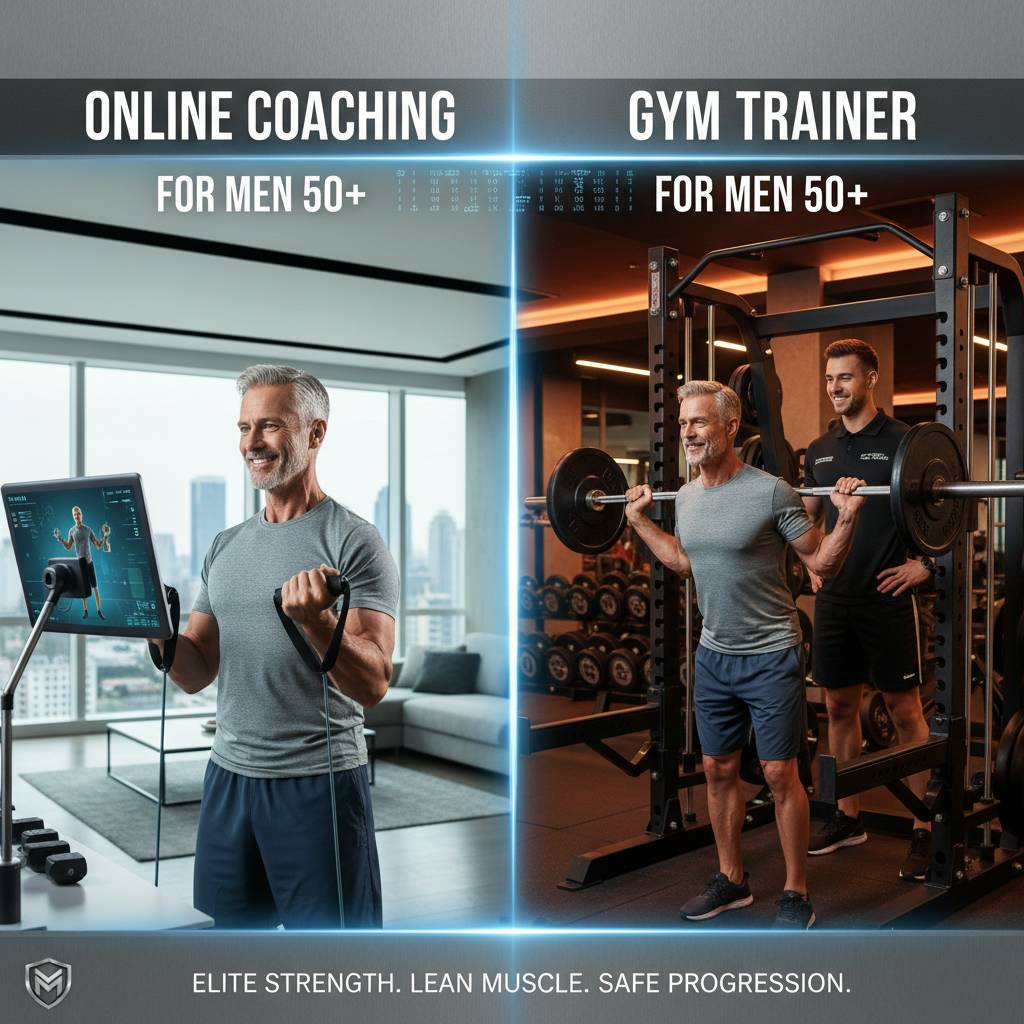 Different goals naturally favor different delivery methods. For strength-focused older men who want to lift heavy and increase muscle mass, initial in-person coaching for technique and spotting can accelerate safe progress. Once movement patterns are reliable, online maintenance coaching with progressive overload and occasional in-person check-ins works well. For mobility, balance, and fall prevention, in-person guidance may be more effective at first to ensure safe movement patterns, but online programs with clear demonstrations also produce strong long-term outcomes.
For weight loss and general conditioning, online coaching often excels because of flexibility and the emphasis on consistent, daily behaviors. Programs that integrate nutrition guidance, habit coaching, and simple home workouts can produce consistent results. If social interaction and motivation are crucial, a gym trainer or group classes can provide the camaraderie and accountability some older men prefer. Consider which environment you enjoy-sustained adherence beats the theoretically optimal plan that you won't stick with.
Profile 1: Retired David, 68, no major medical issues, limited to light home equipment. He values flexibility and prefers training in the morning at home. Online coaching with weekly video reviews and a simple progressive plan fits him best, supplemented by a monthly in-person check to reassess form.
Profile 2: Active Mark, 72, history of knee replacement and balance concerns. He benefits from an in-person gym trainer initially to integrate rehab principles, supervise exercises, and adjust load safely. After stability is restored, he transitions to hybrid coaching-online programming with monthly in-person sessions.
Whether you're interviewing online coaches or gym trainers, ask about credentials, experience with older clients, and how they handle medical complexity. Good questions include: How do you screen new clients? How do you modify plans for joint pain or cardiac limitations? What results can I expect in 12 weeks? How often will you check my form? A coach who provides clear, evidence-informed answers and measurable milestones is worth seriously considering.
Watch for red flags: trainers who promise unrealistic results, offer one-size-fits-all plans, or lack a documented screening process. Also be cautious if a trainer discourages communication outside sessions or avoids collaborating with medical professionals when needed. Good practitioners prioritize safety, transparency, and measurable progress.
You don't need to commit exclusively to one mode forever. Many older men find a hybrid model the most practical: begin with in-person sessions to learn movement mechanics, then switch to online coaching for maintenance and consistency. Alternatively, use online coaching as the primary modality and schedule occasional in-person sessions to reassess and refine technique. This blended approach captures the strengths of both methods without requiring significant compromises.
When transitioning, set clear milestones: a date or performance goal for moving from in-person to remote, or a schedule for periodic in-person "check-ins." Document your baseline metrics-strength tests, mobility screens, and simple functional measures-so progress is obvious regardless of the delivery mode. Consistent tracking allows your coach, whether remote or local, to make intelligent adjustments that protect health and accelerate outcomes.
Use this quick checklist to move toward a decision: 1) Define your top 2 goals; 2) Note any medical limitations; 3) Decide how much hands-on supervision you need; 4) Set a budget range; 5) List equipment access and proximity to a gym. Matching answers to these points will narrow choices rapidly and reveal whether online coaching, a gym trainer, or a hybrid approach best suits your needs.

If you're ready to move forward but unsure which path fits you best, Mature Male Fitness Coach offers a complimentary consultation to review your goals, health history, and practical constraints. That short conversation clarifies whether online coaching vs gym trainer for older men will produce faster, safer results given your circumstances. Mention your priorities and we'll recommend a tailored plan that respects your budget and lifestyle.
To schedule a consultation, call 14707441483 or request a brief intake form. Whether you prefer a fully remote plan, in-person sessions, or a hybrid model, Mature Male Fitness Coach will help you choose an approach that minimizes risk and maximizes long-term consistency. If you like, ask for MMFC during your call to connect with someone who specializes in older adult fitness.
Make the decision today that keeps you strong, independent, and active. Contact Mature Male Fitness Coach at 14707441483 to discuss personalized options and take the first step toward a safer, more effective training plan tailored to your life.
